
Using the Number Grid
In the primary grades at Pittsfield Elementary School, our Everyday Mathematics curriculum includes many counting activities that use number grids. For example, we might have children count by 10s starting at 17 (17, 27, 37, 47, 57) or count backward by 10s starting at 84 (84, 74, 64, 54). Parents can use number grids at home, too.
Number grids can be used to explore number patterns. For example, children can start at zero and count by 2s. If they color each box as they go, they will have colored all the even numbers. If they start at one and count by 2s they will color all the odd numbers. If they count by 5s, starting at zero, they will color numbers with 0 or 5 in the ones place.
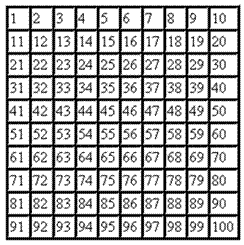
Number grids are also useful for addition and subtraction. For example, to find the difference 84-37 you can:
*Count the tens from 37 to 77 (4 tens) and the count the number of ones for 77 to 84 (7 ones). So 84 – 37 is 4 tens plus 7 ones, or 47. This difference corresponds to the distance between the points 37 and 84 on a number line.
*Start at 84 and count back to 37, noting as before how many numbers have been counted.
* Count back 37 from 84 by tens and ones: 74, 64, 54, 53, 52, 51, 50, 49, 48, 47.
Addition problem can also be solved on the number grid using similar methods. The number line simplifies “double counting”, or counting the numbers of numbers counted, that is required in many addition and subtraction procedures.
By identifying number patterns in grids, younger students build concepts for divisibility rules, prime numbers, and factoring in later grades. Have your child show you how the number grid is used in his or her classroom! Try it out yourself. It may make you think about mathematics differently.
This article was developed from the Everyday Mathematics Teachers Reference Book, Grades 1-3.